
Most zero day detection strategies are really just zero day recovery strategies. By the time your team knows an edge device was compromised, the attacker has been inside your network for weeks. Obviously, doing forensics on a breach that has already finished is not ideal. This blog is about changing that timeline.
During 2026 multiple threat actors are leveraging AI to be able to rapidly create exploits affecting those edge devices. Frontier models like Mythos are showing that you can do vulnerability research way more faster and at scale. It means that we will probably see a big uptick in the number of zero-day exploits in the wild.
Edge devices are unique because this window is even more catastrophically short. When the Ivanti zero-day went public, devices were compromised within four hours. Most organizations didn’t detect the breach for weeks. By the time security teams started incident response, attackers had already moved laterally, established persistence, and accomplished their objectives.
The Canadian Centre for Cyber Security and their international partners say it best: “Once zero-day threats leveraging unknown vulnerabilities are used and detected, responsible device manufacturers will release patches quickly. Your organization must keep abreast of released patches, fixes or device updates to mitigate known vulnerabilities.” The guidance continues: “Your organization must have procedures in place to action updates and patches immediately, before threat actors can exploit known vulnerabilities”.
But having procedures to patch quickly still doesn’t solve the fundamental problem: detecting when you’re actually being targeted, especially during the window before patches exist or before you’ve deployed them.
Why Zero Days Target Edge Devices
From an attacker’s perspective, edge devices are ideal targets for zero-day exploitation. They’re internet-facing by design, making them discoverable and reachable. They provide direct access to internal networks…no need to compromise individual employees through phishing or social engineering. And they’re difficult to monitor with traditional security tools.
Threat actors use tools like Shodan and Censys to enumerate every instance of a specific edge device on the internet. When a zero day drops, they have an instant target list. Advanced persistent threat groups target specific organizations including governments, defense contractors, critical infrastructure operators. Ransomware groups take the volume approach, hitting thousands of devices simultaneously.
Both strategies work because edge devices lack the defensive depth that internal systems have. There is no EDR monitoring process execution or behavioral analysis detecting anomalous activity, and limited logging misses most post-exploitation behavior. When attackers exploit an edge device zero day, they’re operating with minimal visibility and maximum access.
The Detection Timeline Gap
Traditional detection for edge device compromises looks like this:
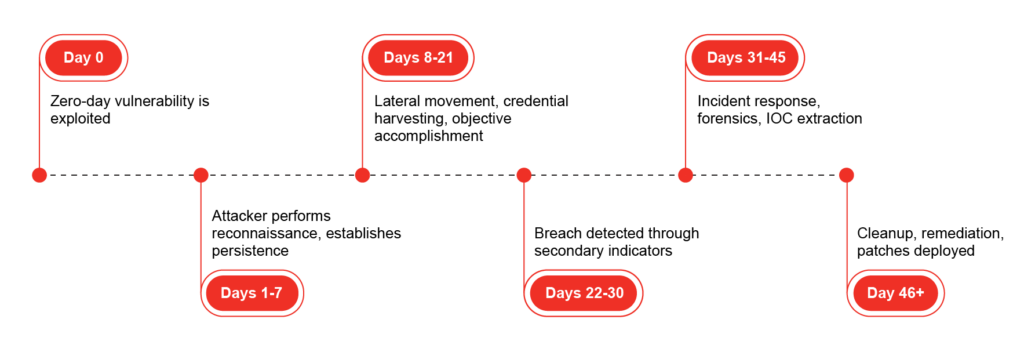
This timeline is optimistic. Many organizations take even longer to detect edge device compromises. The NCSC’s guidance on edge device forensics notes that “these actors can remain inside networks until detected and denied access.” The implication: detection is neither automatic nor fast.
By the time incident response begins, the threat intelligence is stale and malware has evolved. The C2 infrastructure has changed and TTPs have been updated for subsequent campaigns. Security teams are analyzing an attack that finished weeks ago, using indicators that may no longer be relevant.
What Effective Zero Day Detection Looks Like
Effective zero-day detection for edge devices requires three capabilities that traditional security products don’t provide:

Immediate detection of exploitation attempts
You need to know when zero-day exploits are being deployed against your edge devices immediately, not weeks after successful compromise. This means having visibility into exploitation attempts as they happen, during active campaigns.
Real-time intelligence collection during active exploitation
When zero days are being actively exploited, you need to capture the exploit payloads, the post-exploitation behavior, and the attacker infrastructure while it’s current. That way you are not working from outdated intel.
No risk to production systems during intelligence collection
You can’t use production edge devices for security testing or deep monitoring without risking operational disruption. Zero day detection needs to work without touching production infrastructure.
Traditional security approaches can’t deliver these capabilities for edge devices. You can’t install monitoring agents without breaking functionality. You can’t take devices offline for analysis during active campaigns. You can’t gather post-exploitation intelligence from devices that weren’t designed with forensic visibility in mind.
Proactive Zero Day Detection Through Deception
The solution is creating monitored environments that attract and capture zero-day exploitation attempts without risking production systems. This means deploying edge devices specifically for intelligence collection. These systems are digital twins of sorts that look and behave exactly like production infrastructure but exist solely to detect and analyze attacks.
When zero day campaigns launch, these systems get hit first. Unlike production devices where compromise goes undetected, these are instrumented to capture everything from the initial exploitation attempt through all post-exploitation activity.
“Imagine getting the exploit payload itself on a zero day vulnerability attack. Imagine being able to track the attackers’ every move after a successful compromise stemming from a zero day attack.“
Pre-exploitation capture provides the exploit payload itself. The full inbound request content is logged, including every detail of the zero-day exploit. This enables immediate signature creation and IOC development. Security teams can develop detection rules and protective measures while the campaign is still active.
Post-exploitation visibility shows what attackers do after successful compromise. Every command executed, every file accessed, every network connection established…all captured in real time. This is what our deception decoys reveal: attacker objectives, techniques, and infrastructure. It’s the intelligence you need to check production systems for similar activity and respond before damage occurs.
The architecture scales through transparent gateways called satellites. These lightweight satellites sit in front of edge devices and capture all traffic while transparently forwarding it to the actual device. Attackers receive authentic responses because they’re interacting with real infrastructure, but every action is logged.
You can deploy satellites using your organization’s actual domain structure. When attackers enumerate edge devices through reconnaissance, they discover these satellites along with your production systems. They attempt exploitation. You capture everything. Your production devices stay untouched.
Download this datasheet to find out more about how this works.
The Intelligence Advantage During Zero-Day Campaigns
When a zero day affecting edge devices goes public, organizations deploying this approach have a significant advantage. While others are scrambling to understand if they’ve been compromised, these organizations already have:
- Fresh exploit samples captured during active campaigns, not extracted during post-incident analysis weeks later
- Current C2 infrastructure that’s still operational, enabling network-level blocking and monitoring
- Real TTPs showing exactly how attackers are exploiting the vulnerability and what they’re doing afterward
- Actionable IOCs that can be immediately checked against production systems
- Lead time of 24-48 hours to secure production infrastructure before exploitation reaches it
This intelligence is immediately shareable. When you capture a zero-day exploit against a FortiGate device, every organization running FortiGate can use those IOCs to check their own infrastructure. When you see post-exploitation behavior, you know what to look for in your environment. When you identify the malware and C2 infrastructure, you can block it proactively.
Real-World Zero-Day Scenarios
Let’s think about how a typical zero-day scenario goes without proactive detection:
Vulnerability disclosed or exploited in the wild. Security team learns about it through vendor notifications or threat intelligence feeds. Team begins emergency patching process, which requires testing and scheduled maintenance windows. During this window, attackers are actively exploiting the vulnerability. Production devices get compromised. Weeks later, compromise is detected through secondary indicators. Incident response begins, but intelligence is already stale.
Now, consider the same scenario with proactive zero-day detection:
Vulnerability is exploited in the wild. Deception systems get hit within hours. Exploitation attempts are captured with full payload details. Post-exploitation activity reveals attacker objectives and infrastructure. Security team has IOCs and TTPs while the campaign is active. Production systems are checked for similar indicators. Patches are prioritized based on confirmed targeting. Response happens before widespread compromise, not during cleanup.
In the first scenario, detection happens after attackers have already succeeded. In the second, detection happens during the campaign, when the intelligence is still actionable and production systems can still be protected.
Curious to find out more? You can watch our Edge Device webinar on demand here to hear David Barroso talk about how this works in real-life scenarios.
Deployment for Zero Day Detection
Organizations deploying this approach for zero-day detection typically run multiple campaigns targeting different edge device types. One campaign might focus on VPN concentrators, another on firewalls, another on MDM solutions. Each campaign uses either deployed decoys running actual hardware or transparent satellites redirecting to production infrastructure.
The satellites approach is particularly effective for zero-day detection because it’s fast to deploy and easy to scale. Under 60 seconds to get a new satellite operational. No hardware procurement. No complex configuration. Just lightweight systems that transparently capture and forward traffic.
When a new zero-day emerges, organizations can rapidly deploy additional satellites to maximize coverage. More entry points mean higher likelihood of detection. More intelligence collected means better understanding of the threat. More IOCs and TTPs mean stronger defenses.
Moving Beyond Reactive Defense
Zero day vulnerabilities will continue affecting edge devices. The vulnerability disclosure cycle guarantees it. Remote work patterns ensure edge devices remain essential and exposed. Nation-state actors and ransomware operators will keep investing in finding and exploiting these vulnerabilities.
Organizations that adapt their approach to zero-day detection will be the ones that detect and respond to threats during active campaigns, not during post-incident cleanup. They’ll have the intelligence advantage that comes from seeing attacks unfold in real time. They’ll have the lead time that comes from detecting targeting before production systems are compromised.
Zero-day detection for edge devices requires rethinking detection, intelligence collection, and response timelines. The old approaches aren’t working. We are working on new ones that are proactive, scalable, and built specifically for the unique challenges these devices and these threats present.