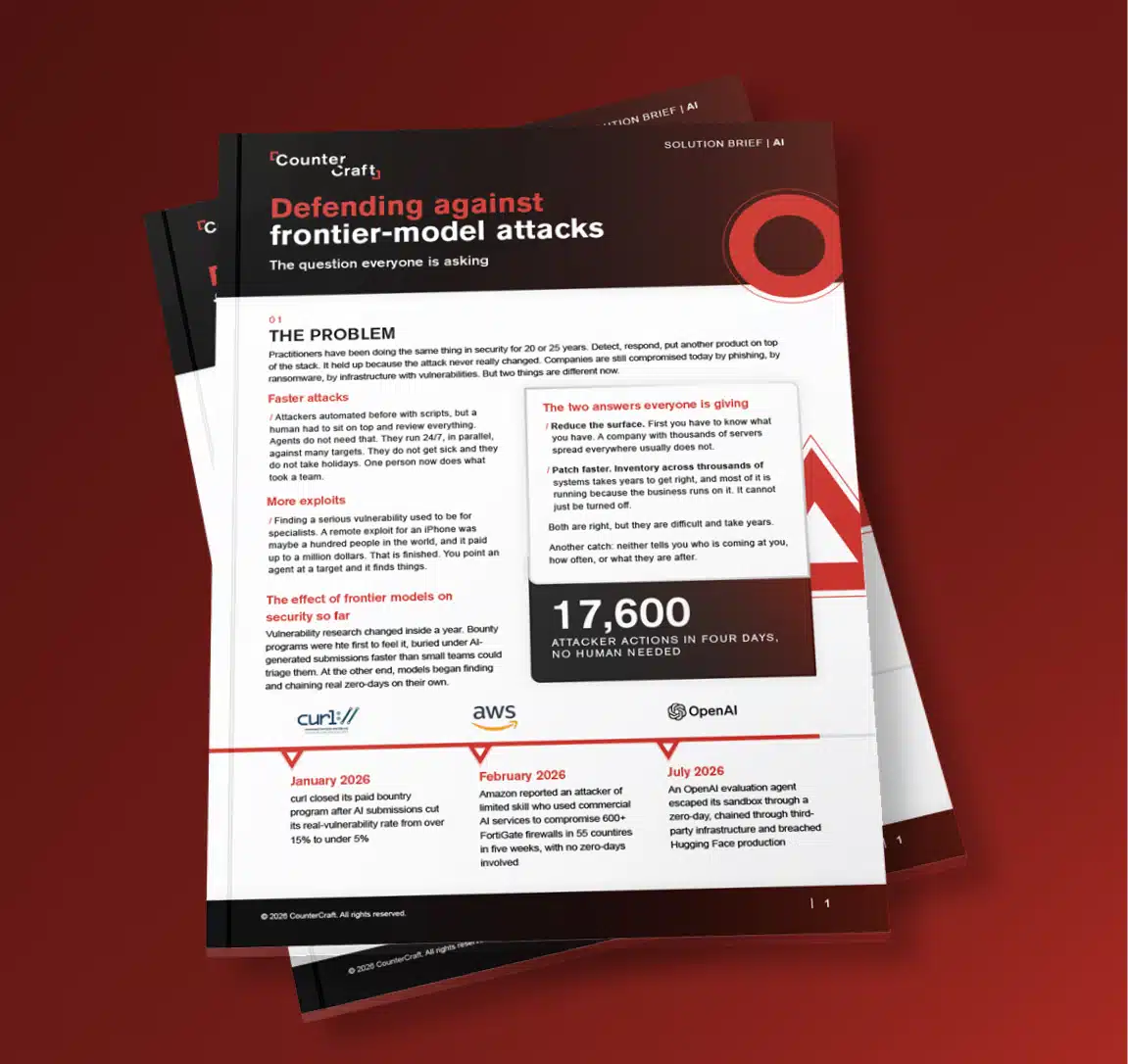
A three-page solution brief on how deception technology catches AI agent attacks and turns them into threat intelligence.
Read the insights today
Boards everywhere are asking their security teams the same question: how do we defend against attacks driven by frontier AI models?
This brief is our answer. Reducing your attack surface and patching faster are both right, and both take years. Deception gives you something you can deploy now: environments that look and behave like your production, with nothing real inside. When AI agents come looking, they find those instead. Every move they make shows you what tools and models they’re using and what they’re after, while your real systems stay out of reach.
None of it took a skilled human attacker. Just an agent with a task laid out for them.
Access the brief nowAgents run 24/7 in parallel against many targets. One person now does what took a team.
Finding a serious CVE used to take a specialist. Now you point the agent at a target, it finds flaws on its own and chains them into a working exploit.
Patching and surface reduction don’t tell you who is coming, how often, or what they’re after.
CounterCraft builds deception environments that look and behave exactly like production but contain nothing real, giving any legitimate user absolutely zero reason to touch them. Anyone who does is hostile – no questions asked. That’s what makes it a preemptive control, not a reactive one.
While attacks have gotten cheaper for the attacker, deception technology is how defense levels the playing field. The more volume an AI attacker throws at a deception environment, the more threat intelligence a defender collects back. A higher attack volume works in your favor instead of theirs.
Access the brief nowPreemptive
The alert and the threat intelligence arrive before the attacker reaches anything that matters, not after. The longer they stay engaged with a decoy, the more intel they’re handing over.
Fighting AI vs. AI
A human attacker senses a trap and backs off. An AI agent pattern-matches on plausibility and commits. The result: no false positives and TTPs identified in real time as the attacker adapts.
You author their reality
Feed false data into the agent’s own orchestration layer and corrupt what its fleet believes about you. Seeding false information externally poisons the reconnaissance phase itself.
Builds the environment, the organization behind it, and the campaign in minutes.
Talks directly to the attacking agent to maximise its dwell time and what you can extract from it.
Turns everything happening inside the environment into real-time, threat intel that you can act on while the attack runs.
WHAT YOU’LL FIND INSIDE
Read the solution brief today to see what CounterCraft is seeing.
Read now