Ransomware attacks spike during the holidays, targeting retailers when they’re most vulnerable. Learn how to defend your business with deception technology.
While most of us are sitting down to enjoy a holiday meal with family and friends, threat actors are putting carefully designed retail ransomware attacks into motion, operating with clear intent and seeking to disrupt retail at the busiest time. During just one day of holiday shopping on Black Friday 2025, U.S. consumers spent $11.8 billion online. Attackers know that any interruption to payment systems during these high-revenue holiday periods can force quick, costly decisions for retailers. The frequency is relentless: as of 2025, a ransomware attack occurs about every 19 seconds worldwide.
The timing is intentional. According to recent data, 52% of ransomware attacks now occur on a weekend or holiday. Attackers anticipate that defensive responses will be slower. They are right: 78% of organizations with a Security Operations Center (SOC) cut staffing by 50% or more during holidays to give teams a break. This gap between peak attacker activity and reduced defender capacity creates a dangerous window of exposure.
Download our data sheet on how to improve retail cybersecurity here >>>>
Retail Ransomware Attacks on the Rise Over the Holidays
The retail sector remains a favorite target for ransomware attacks, responsible for 9% of all ransomware incidents globally. In the past year alone, 80% of retailers reported experiencing a cyberattack, with 52% indicating their risk increases during the holiday shopping season, more than at any other time over the year.

The pattern repeats. In November 2024, supply chain software provider Blue Yonder was hit the week before Thanksgiving. The attack disrupted operations for Starbucks, Morrisons, and Sainsbury’s. Starbucks had to revert to pen-and-paper scheduling for 11,000 North American stores and Morrisons saw warehouse systems for fresh produce go offline, forcing manual workarounds heading into peak shopping season. Or there’s the ransomware attack that knocked out payroll systems for over 2,000 businesses, including major brands like Tesla, PepsiCo, and Whole Foods. The attack, striking at the height of the holiday season, meant delayed paychecks and lost productivity across the supply chain.
It’s doubly difficult when the ransomware comes from sophisticated threat actors. The DragonForce ransomware group infiltrated the company’s network as early as February and, after weeks of undetected access, deployed ransomware in April. Their actions disrupted contactless payments and online orders, forcing the retailer to halt e-commerce activities and temporarily rely on pen and paper. The attack resulted in the theft of customer data and an estimated loss of £43 million per week in sales, demonstrating how long adversaries may remain undetected and the wide-ranging impact of a well-timed ransomware campaign during peak retail periods.
Find out how retail organizations have stopped ransomware in its tracks in this datasheet >>>
Protecting Against Retail Ransomware
Industry leaders recommend a layered approach to strengthen retail cybersecurity, especially during the holiday season when risks are highest. Essential measures include regular software patching, targeted employee training, robust access management, and rehearsed incident response plans. But these baseline cybersecurity measures are not enough for the tactics of modern ransomware groups.
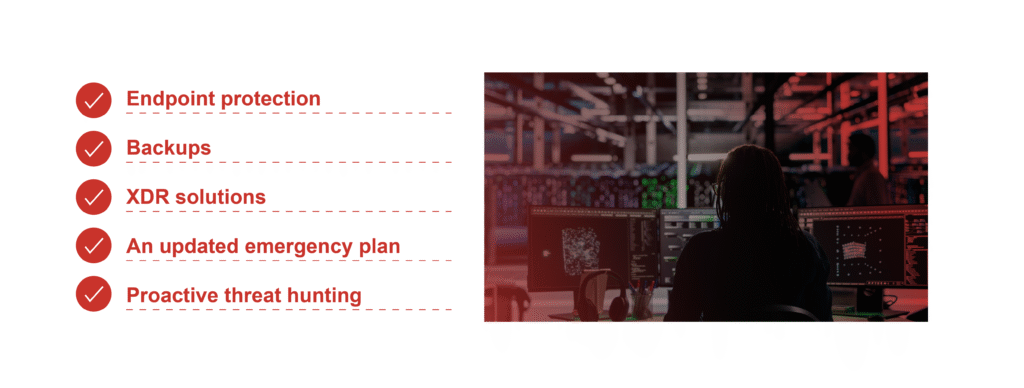
The most effective security teams go beyond basics with proactive threat hunting, actively seeking out threats before they escalate. This shifts defenders from a reactive to a forward-leaning posture, identifying malicious activity early and limiting an adversary’s opportunity.
Cyber deception is a proven strategy for proactive threat hunting. By deploying high-fidelity decoys and digital twins that mirror your actual IT, OT, and cloud environments, retailers can lure attackers away from core systems, observe their techniques, and gather intelligence without exposing critical data. CounterCraft The Platformexcels here: it detects ransomware activity in its early stages by introducing deception buffer zones, delivering specific, actionable, real-time intelligence that you can then use to protect your network.
Here’s how this threat intelligence works in practice:
- Deploy deception: Introduce buffer zones and decoy assets that require minimal operational overhead from your threat intelligence team.
- Detect threats in real time: Identify when ransomware actors are probing the environment or moving laterally, even before they reach sensitive assets.
- Collect focused intelligence: Gain actionable insight into the TTPs (tactics, techniques, and procedures) of real attackers targeting your infrastructure, without adding to alert fatigue.
- Respond rapidly: Use this adversary-generated intelligence to drive fast, informed actions, reconfiguring defenses or isolating endpoints as needed.
CounterCraft delivers these capabilities with a deception-powered threat intelligence platform built for overstretched retail SOC teams. Retailers can detect ransomware campaigns at the earliest stage, gather the intelligence required to respond decisively, and keep business operations (and customer trust) intact, even during peak periods.
This is how CounterCraft’s deception technology empowers retailers to stay ahead of retail ransomware threats during the busiest times of the year:
- Zero Noise Detection: In a standard SOC, analysts drown in alerts. Deception is different. If an alert fires, it is a confirmed threat. This gives skeleton crews working holiday shifts the confidence to act immediately.
- Actionable Intelligence: CounterCraft doesn’t just block; it observes. It generates specific, adversary-generated intelligence by watching how the attacker moves within the decoy environment. You see their tools, their targets, and their intent in real time.
- Safe Engagement: By redirecting attackers to “digital twins”, you keep them away from your actual point-of-sale systems and customer databases. You waste their time and resources while your production environment remains secure.
See it for yourself
Protect your retail and e-commerce organization this holiday season. Find out how CounterCraft’s The Platform generates specific, actionable, real-time threat intelligence powered by deception to protect the retail industry.
Spend 20 minutes with us to see why the world’s most sophisticated organizations, including the U.S. government, are using our deception technology platform for active cyber defense, freeing up resources and staying ahead of threat actors.