

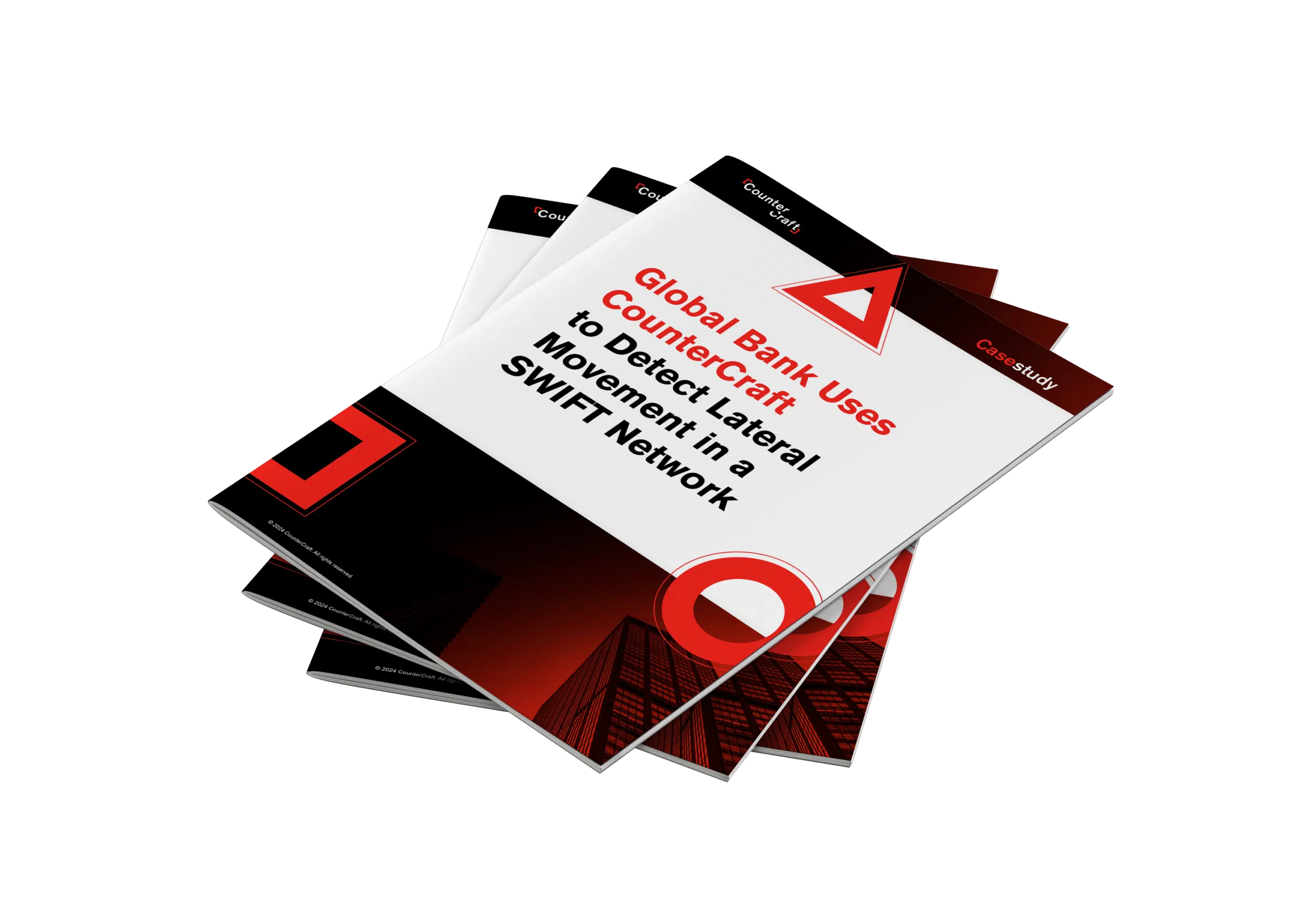
What you’ll learn:

Download this cybersecurity case study to find out how our deception-powered threat intelligence platform helped our client to detect red teams and unauthorized users accessing their SWIFT networks and harden their security system with the threat intelligence gathered.

Download this cybersecurity case study to find out how our deception-powered threat intelligence platform helped our client to detect red teams and unauthorized users accessing their SWIFT networks and harden their security system with the threat intelligence gathered.

Frequently Asked Questions (FAQ)
Lateral movement describes the actions an attacker takes after initial access to move through a network. This often includes exploring systems, escalating privileges, and identifying higher-value targets. It is a common phase in targeted attacks and is often difficult to detect with perimeter-focused tools.
Lateral movement allows attackers to expand access without triggering obvious alarms. It brings them closer to sensitive systems, credentials, and data. By the time it is detected, attackers may already have established persistence or prepared a larger impact.
CounterCraft places realistic decoy assets throughout the environment that mirror real systems and access paths. When attackers attempt to move laterally, they often interact with these assets. These interactions provide immediate visibility into attacker behavior and progression. Find out how deception powers preemptive cybersecurity with a demo.
Decoy assets are not part of normal user workflows. Legitimate users and systems do not interact with them during routine operations. As a result, alerts generated from these interactions are highly reliable indicators of malicious activity.
Yes. The platform detects lateral movement originating from external compromise as well as activity that starts inside the network. This includes stolen credentials, misuse of privileged accounts, and insider-driven movement across systems.
Early visibility gives teams time to contain threats before critical systems are reached. Seeing how an attacker moves helps responders understand scope and intent. This supports faster, more targeted containment decisions.
Yes. Intelligence from attacker interactions can be shared with existing SOC workflows. This helps teams enrich investigations and correlate activity without changing their core tooling.
Security operations teams, incident responders, and threat hunters benefit most. It is especially valuable in environments targeted by sophisticated adversaries or where credential abuse is common.
It is the phase where attackers move across systems after gaining access. This activity often blends in with normal traffic. Detecting it requires visibility inside the network.
Monitoring interaction with decoy assets provides immediate signals. These assets are only touched during malicious exploration. This allows detection while the attack is still in progress.
Early detection is key. Identifying movement paths quickly allows teams to isolate accounts, segment access, and contain the attacker before impact occurs.