
Cyber deception operations turn decoy technology into an active defense capability. The most effective programs learn from real attacker behavior and adapt as threats change.
Deception technology has widely been accepted as a game changer in cyber defense. As you know by now if you use deception, or read this blog, the old honeypot has long been left in the dust in favor of cyber deception operations, advanced ops that put deception technology to real use and turn simple decoys into an ongoing active cyber defense capability. At a time when AI is making malicious activities like vulnerability exploitation and reconnaissance faster, a clear plan has never been more important.
What are Cyber Deception Operations?
Cyber deception operations are the ongoing strategy behind deception. Security teams plan where to place deception assets to identify adversaries early, watch how attackers interact with them, and use what they learn to improve the next defensive move.
Here’s the difference between placing a decoy and running deception operations. A static honeypot sitting in a corner of your network is a trap. It waits. It can alert you to a touch. But a deception operation is an active discipline built around influencing and observing adversary behavior, then feeding that insight back into your defenses.
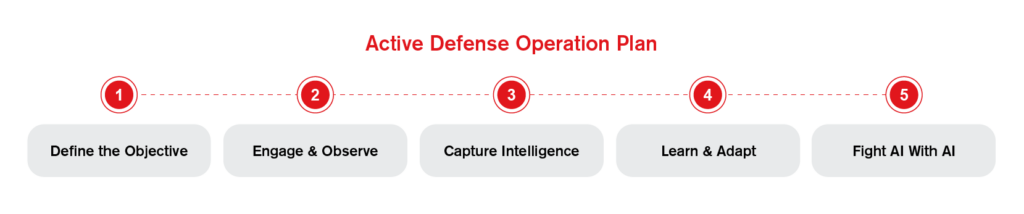
The UK’s NCSC reached a similar conclusion after trials involving 121 organizations and 14 commercial deception providers (including CounterCraft). Deception can really change the game. This guide gives you a five-step plan to run cyber deception as an active defense operation, from planning and engagement through to collecting intelligence and adapting to any novel threats, regardless of technique. Follow these steps and you’ll give your teams insight they can use without the alert fatigue.
1 / Start With What You Want to Know
The best place to start devising a cyber deception strategy is by deciding what you need to uncover. Consider the gaps in your current defenses and how deception can help fill them.
Think through attackers’ likely routes. Are you trying to spot attacker reconnaissance before a breach, or expose lateral movement once someone gets inside? Where are your blind spots? Which assets would attract an attacker’s attention, and what would they expect to find around them?
From there, security teams can manipulate the environment with purpose. Place believable digital twins and breadcrumbs along likely attack paths, including around external-facing services, cloud infrastructure, or high-value systems. The assets should resemble the real environment closely enough that an attacker has a reason to trust what they see.
This campaign-based approach lets teams build deception around a specific threat rather than scatter generic traps across the network. It also creates the conditions for early threat detection. When an attacker follows a carefully placed breadcrumb or probes a false asset, defenders know exactly why that asset was there and what that interaction may reveal.
2 / Cyber Deception Operations Deliver More Than an Alert
A well-placed decoy has no reason to attract legitimate visitors. When someone interacts with it, defenders get a high-confidence signal that deserves attention. But it’s way more than the alert that deception delivers.
Instead of shutting down the connection immediately, security teams observe the attacker in the isolated deception environment. TTPs get piped directly into security framework, everything from:
- The commands and tools they use
- Routes attackers take to explore your environment
- Attempts to escalate privileges or reach other systems
The longer the adversary believes the environment is real, the more they reveal. Attackers exploring one CounterCraft client’s system spent three hours inside a deception environment, even deploying criminal tooling because they believed it was genuine, giving the client invaluable intelligence. Deception can also prey on their paranoia, forcing them to question whether what they see is genuine while giving defenders more time to respond.
Adding deception to the controls that already protect your production systems and active credentials gives attackers fewer safe paths to follow.
3 / Turn Attacker Behavior Into Usable Intelligence
As attackers move through your deception environment, they create a detailed record of their behavior. Security teams can capture the TTPs they use, indicators of compromise, and attempted movement through the environment. CounterCraft The Platform then automatically maps this activity against MITRE ATT&CK to add context and help your analysts understand how attacks develop.
You can also evaluate your adversaries’ intent. By observing which systems attackers target and how they attempt to reach them, defenders gain insight into their objectives and capabilities. This generates cyber threat intelligence from real attacker activity specific to your organization, rather than from generic external feeds. The intelligence you gain can feed into existing SIEM, SOAR, and XDR workflows, bringing more context to the wider security stack. Intelligence gathered from external deception can also guide threat hunting inside the real network or expose controls that need strengthening.
4 / Learn From Every Engagement
A strong cyber deception operation will adapt as attackers reveal more about themselves. If an engagement exposes a new route, technique, or weakness, use that intelligence to adjust the next campaign and strengthen your real environment. That might mean changing a breadcrumb, altering the route through a digital twin, or updating the controls protecting the system an attacker tried to reach. The aim is to create a continuous feedback loop: detect, act, observe, and adapt.
Finally, measure what matters. Engagement time, attacker behavior, and the techniques attackers reveal can all indicate whether the operation is producing useful intelligence. For example, did the attacker change their behavior after interacting with the decoy environment? If so, your team has another signal to investigate and learn from.
5 / Fight AI With AI
AI is a double-edged sword. It makes attackers more effective, and it can do the same for defenders. But first, as defenders, we need to understand what we’re dealing with.
AI compresses the time defenders have to work out what an attacker is doing. Generative AI can speed up reconnaissance and vulnerability research, while also helping attackers prepare phishing campaigns or develop malware more efficiently. AI weaponizes new vulnerabilities in hours. Much of that work happens before conventional security tools see anything obviously malicious, and the tools we’ve relied on were calibrated for a human-paced world: signatures are dead, SOC triage loops can’t keep up, and awareness training assumed human error at human speed.
That compressed window makes it essential to discover attacker intent early, and that’s where AI-powered cyber deception operations excel. Deception plays on the central weakness of what AI is: it has no way to check what is real, so it is easily confused and consistently chooses the path of least resistance. Where a human attacker can smell a trap and test before committing, AI agents pattern-match on plausibility and commit.
AI-powered cyber defense can then process larger volumes of attacker behavior and reshape the deception environment in response. Instead of a fixed set of assets, a more dynamic operation could:
- Introduce additional believable infrastructure as the attacker explores
- Reconfigure decoy assets according to what the attacker does
- Feed false data, false paths, and false assets into the agentic orchestration layer
- Use fresh telemetry to influence the next defensive action
- Plant material on the dark web to poison the agentic attack in its planning phase, before it ever reaches you
Every interaction inside that environment is a high-fidelity alert. There is no legitimate operational reason to touch a deception environment, so there are no false positives to work through, and what you get back is real-time threat intel specific to your own attack surface. It is also TTP agnostic, which means brand new techniques with no precedent get identified the same way known ones do.
In short, AI-enabled deception can help you respond to AI-powered cyber attacks faster and with a better chance of success. Attacks got cheaper for them. Defense just got cheaper for you.
That does not mean fully autonomous defense is ready to run unchecked. AI isn’t infallible, and human oversight over automated decisions is still essential. Deception is the one place where that risk is already contained: the deception environment is isolated from production by design, so an agent operating there is working on ground built to be attacked.
But the direction is clear. Preemptive cybersecurity is becoming an increasingly fast-paced contest between adaptive attackers and defenses that learn from them. Deception was built for this moment.
Cyber Deception Operations are Key to Active Defense
Deception becomes active defense when every attacker interaction improves what defenders do next. You shape what adversaries see, observe how they respond, and use that intelligence to make better defensive decisions. As attacks become faster and more automated, that cycle matters even more.
CounterCraft uses realistic digital twins to engage adversaries safely and turn their behavior into specific, actionable threat intelligence. That intelligence helps security teams understand the threats targeting their own organization and respond with greater confidence.
See how CounterCraft turns real attacker interactions into intelligence you can use. Request a demo today.