
Choosing an enterprise deception security platform comes down to seven operational outcomes: trusted alerts, attacker intent, workflow fit, active defense, scale, AI readiness, and measurable results. This guide walks through each one.
Breadcrumbs. Honeypots. Lures. Digital twins. If you’re in the market for an enterprise deception security platform, vendors will hit you with a barrage of features, all to convince you that their solution is the best. However, long feature lists do not tell you how well a platform will perform in real operations. The challenge is distinguishing between capabilities that look impressive in a demo and those that deliver operational value in the SOC.
That evaluation has become harder in the last year. Attackers are now running AI agents that probe continuously, move faster than any human team, and adapt as they go. Every vendor has responded by adding AI to their messaging. Few can explain what it changes about the way their platform performs against an automated adversary.
Will your platform give your SOC team a clear signal when an attacker starts probing? Will it add context, or just create more noise? Will the intelligence flow into the solutions you’re already using? That’s much more helpful to know.
Each section of this guide tackles a different question to help you judge how a deception platform will perform in everyday operations. Armed with this knowledge, you’ll be able to make the right decision for your organization.
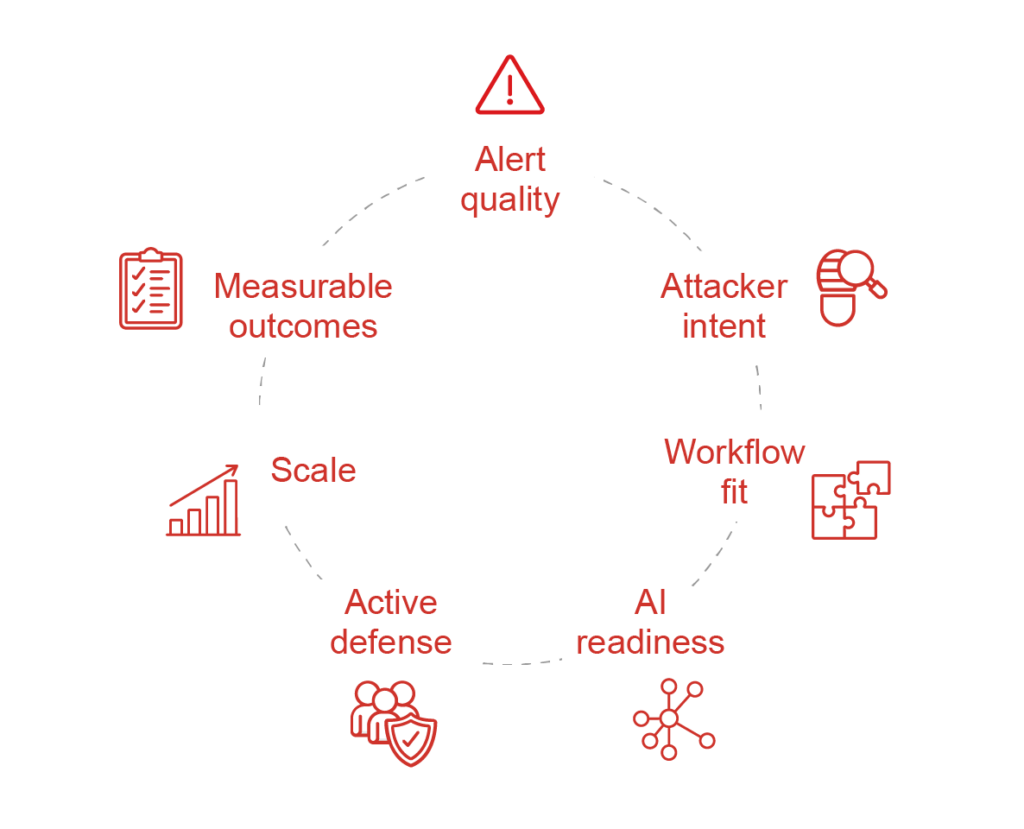
As you compare deception security platform vendors, score each platform again these seven criteria:
- Alert quality: does it produce high-confidence signals?
- Attacker intent: does it explain objectives, not just events?
- Workflow fit: does it slot into your SOC and IR processes?
- Active defense: does it support threat hunting and detection engineering?
- Scale: does it grow across the enterprise without overhead?
- Measurable outcomes: can you prove the value it delivers?
- AI readiness: does it detect and engage automated adversaries, and does it use AI to reduce your workload?
1. Does the Platform Generate Alerts Your Analysts Can Trust?
Start with the signal. An enterprise deception security platform has little value if it just creates a mess of vague alerts that your (already overloaded) SOC team has to untangle.
The value of deception rests on a simple concept: proactive defense. Legitimate users have no reason to interact with a decoy. When someone does, the activity carries clear intent. Your analysts should be able to see what the intruder accessed and what they tried to do, without wasting time proving the behavior was malicious.
Look closely at when a platform detects activity. The best threat detection systems can surface adversary behavior during reconnaissance, after initial access, and while an attacker conducts lateral movement through the environment. The alert should arrive with enough context to help contain the threat and respond quickly.
This matters more against automated attackers. AI agents probe every exposed surface at once, so detection that depends on recognizing a known pattern falls behind quickly. Deception has no such dependency. Anything interacting with a decoy is hostile by definition, whether it is a person or a process, and the signal arrives at the same confidence level either way.
In one engagement with a global bank, CounterCraft’s decoy SWIFT portal captured five access attempts from a red team and unauthorized users in less than an hour. The bank’s other security tools did not detect the lateral movement. That kind of early, unambiguous signal is what separates a well-deployed deception platform from the rest of the security stack.
Ask the vendor: What triggers an alert? What evidence does it contain? Then get real examples of activity their platform caught when conventional controls missed it.
2. Does It Explain What the Attacker Wants, or Just What Happened?
Generic cyber threat intelligence shows how an attacker entered an environment and the techniques they used. That helps, but leaves the biggest questions unanswered: is someone targeting your organization right now, and what are they trying to reach?
This is the difference between a feed-based threat intelligence platform and one that producesadversary-generated threat intel. Deception gives you evidence drawn from activity against your own attack surface. When an adversary interacts with a decoy or digital twin, the platform follows their progress through the environment and records the choices they make along the way. It shows which systems attract their attention and how they adapt when they meet resistance. Any tools or credentials they use become part of that picture with MITRE ATT&CK mapping tying those actions to known TTPs, helping SOC teams better understand the attack.
Adversary-generated intelligence also tells you whether you are dealing with a human or a machine. The pace, consistency, and reaction to unexpected conditions all look different when an agent is driving. Knowing which one you are facing changes how you respond, and it is not something a threat feed can tell you.
That level of context makes the intelligence far more useful. Based on real adversary behavior directly targeted at your organization, cybersecurity leaders can assess whether existing controls are working and identify where to invest in further protection.
Ask the vendor: How does your platform explain attacker intent? What data does it record from interactions with the decoy?
3. Will It Fit the Way Your SOC and IR Teams Already Work?
A deception platform should feed the workflows your analysts already rely on. If it sits in a separate console and demands constant attention, adoption will suffer.
Integration is essential, but again, it must go beyond dropping alerts into your SIEM. To make a genuine difference, the platform should pass structured intelligence into the wider cybersecurity stack, so analysts can investigate with more context and act in good time. That should include IOC data and MITRE ATT&CK mappings, adding context to evidence captured from the deception environment. Just as important is how that intelligence supports incident response and case management once an alert fires.
Before you buy, test how the platform performs in a live workflow:
- Does it enrich cases automatically in your SIEM, SOAR, EDR, or XDR tools?
- Can a defined attacker behavior trigger an automated response?
- Does it push evidence into your case management system so responders have a full timeline?
- Does it preserve the logs and event data analysts need for investigation and post-incident review?
Automation is where mature platforms earn their keep. High-confidence alerts are safe triggers for automated response because there are almost no false positives to worry about. That means faster containment and less manual triage.
Ask the vendor: Which integrations are native and what data moves in each direction? How much custom work is needed before the connection can go live? Most importantly, check whether analysts can stay inside the systems they already use rather than monitoring another isolated interface.
4. Can It Support Threat Hunting, Detection Engineering, and Active Defense?
A modern deception platform should help your security team investigate suspected threats and observe attacks in real time, rather than passively waiting for an alert.
For example, if your threat hunters want to test a suspected attack path or revisit an unresolved incident, they can create a deception campaign around that hypothesis by placing breadcrumbs where an adversary is likely to find them. If an attacker follows that trail into a decoy system, the team has clear evidence of hostile activity. This turns a reactive process into a repeatable proactive threat hunting capability, whether you run it in-house or through a managed threat hunting service.
The same activity feeds detection engineering. Real attacker behavior can reveal TTPs that your analysts can use to sharpen detection rules across the rest of the stack.
Of course, for this to work, the deception environment has to convince sophisticated attackers. Then you can observe the attacker for longer, while keeping them away from actual production systems. A crude decoy will not survive much scrutiny. This is where AI has changed what is possible. Building a convincing environment used to take weeks of expert work, which is why most organizations ran deception in a handful of places rather than everywhere it would be useful. AI now generates the full environment in minutes: organization structure, documents, credentials, and infrastructure, built to the same standard as the real thing.
So, when assessing new platforms, make sure they can create realistic digital twins of your real environment, including false credentials and replicas of business-critical assets. Ask any vendor claiming AI capability to show you an environment being generated live rather than one prepared in advance. You should also be able to adapt campaigns when new intelligence comes in. That’s active defense in action.
Ask the vendor: Can you design campaigns around your own threats and unique assets? Then test how convincing the decoys are, how easily campaigns can be changed, and whether the intelligence improves detection elsewhere.
5. Can It Scale Across the Enterprise Without Overhead?
IT environments in enterprise organizations are complex and unique to that specific organization. There will be internal networks, cloud infrastructure, and hybrid systems spread across regions and countries. This presents a challenge when evaluating any new addition to the tech stack.
The important thing is that your new enterprise deception security platform doesn’t add to the workload of your IT and security teams. At the deployment stage, the platform should automate as much of the setup and maintenance as possible. AI-powered campaign building options help teams get started quickly, which matters when specialist deception skills are scarce. When it comes to rollout, this becomes even more critical. More sites should not mean more separate tools, more manual work, or a larger team just to keep the platform running.
Ask the vendor: How quickly can you launch campaigns? How much work do they need after deployment? Does AI help me build my campaigns and adapt to them in real time? Find out whether a single team can manage multiple environments without adding more admin.
6. How Will You Measure the Platform’s Value?
Define what success looks like before you purchase your new enterprise deception security platform. Start with the basics. How quickly does the platform alert after an adversary interacts with a decoy? Does it reduce false-positive investigations? Can your SOC team show that the intelligence has improved detection or changed how you respond to live threats?
You should also look at the quality of the output. Useful IOCs and TTPs matter more than raw volume. The same applies to coverage. A platform that works in one environment but cannot support other business units or cloud systems may have limited value at enterprise scale.
Then, as you evaluate different vendors, ask for evidence. That could include incident examples, deployment times, or reports showing how the platform helped identify activity that other controls missed. A live workflow demonstration can also show whether the intelligence reaches analysts in a form they can use.
Ask the vendor: What tangible impact have you made for other organizations? Talk about the metrics that matter to you to ascertain how well each platform stacks up.
7. Is the Platform Built for AI Automated Adversaries?
The first six questions apply to any deception platform. This one has only become necessary in the last year.
Attackers are running AI agents that probe continuously, work across every exposed surface at once, and adapt without waiting for a human to make the next decision. That changes what you need from a deception platform in two directions: how it performs against an automated attacker, and how much AI does the work for your own team.
On the defensive side, deception holds up unusually well. Detection built on recognizing known patterns struggles when the adversary is generating novel behavior at speed. Deception has no such dependency. Anything interacting with a decoy is hostile by definition, whether it is a person or a process.
There is a second reason deception suits this threat. A human attacker develops instinct. Years in the field teach you when an environment feels wrong, and an experienced operator will slow down and test before committing. An AI agent has no mechanism for that. It works from what it finds and has no way to verify whether any of it is real. Everything inside the environment, the credentials, the documents, the network map, is material you created, which means you shape what the agent concludes and what it reports back to whoever deployed it.
On the operational side, ask what AI does for your team rather than what it does in the abstract. Building a convincing environment has always been the constraint on running deception at scale. Weeks of expert work per campaign is why most organizations deploy it in a handful of places rather than everywhere it would be useful. AI now generates the full environment in minutes: organization structure, reporting lines, documents, credentials, and infrastructure, at the standard required to survive scrutiny.
Be careful here, because this is where claims outrun capability across the whole category. Every vendor has added AI to their messaging in the last twelve months. Ask what is in production today and what is on the roadmap, and expect a straight answer.
Ask the vendor: How does the platform detect and engage an automated adversary rather than a human one? What does AI generate, and can you show it being built live rather than prepared in advance? Which capabilities are shipping today, and which are planned?
What Good Looks Like: Your Vendor Scoring Rubric
Use this table to compare shortlisted vendors. Score each criterion from 1 (weak) to 5 (best in class).
| Criterion | Weak signal | What good looks like | Score (1–5) |
|---|---|---|---|
| Alert quality | Vague, noisy alerts needing triage. | High-confidence alerts with clear evidence and near-zero false positives. | |
| Attacker intent | Raw telemetry only. | Reveals objectives, credentials used, and MITRE ATT&CK-mapped behavior. | |
| Workflow integration | Isolated console. | Native SIEM, SOAR, EDR, XDR, and case management enrichment plus IR automation. | |
| Active defense | Static decoys only. | Custom, adaptable campaigns supporting threat hunting and detection engineering. | |
| Enterprise scale | Manual, per-site setup. | Automated deployment, single-pane management across IT, cloud, and OT. | |
| Measurable outcomes | No proof points. | Demonstrable MTTD gains, fewer false positives, and better analyst efficiency. | |
| AI readiness | AI mentioned in marketing with no operational detail. | AI-generated environments deployed in minutes, automated adversaries detected and engaged, roadmap stated openly. |
A vendor scoring consistently high across all seven is far more likely to deliver real security outcomes than one with the longest feature sheet.
Find the Right Enterprise Deception Security Platform for You
The best enterprise deception security platform will make your security team more effective in the moments that matter. It should give analysts a trusted signal the instant an attacker engages with a decoy, then add enough context to explain what the activity means for your environment.
CounterCraft The Platform follows this model by combining realistic deception environments with specific, actionable threat intelligence. It’s designed to integrate into existing workflows, so it can start adding value quickly. Its AI capabilities are aimed at the two problems that have always limited deception at enterprise scale: the time it takes to build a believable environment, and the expertise required to design a campaign worth running.
Now you know the questions to ask, it’s time to find out the answers. Book a demo with CounterCraft today.