

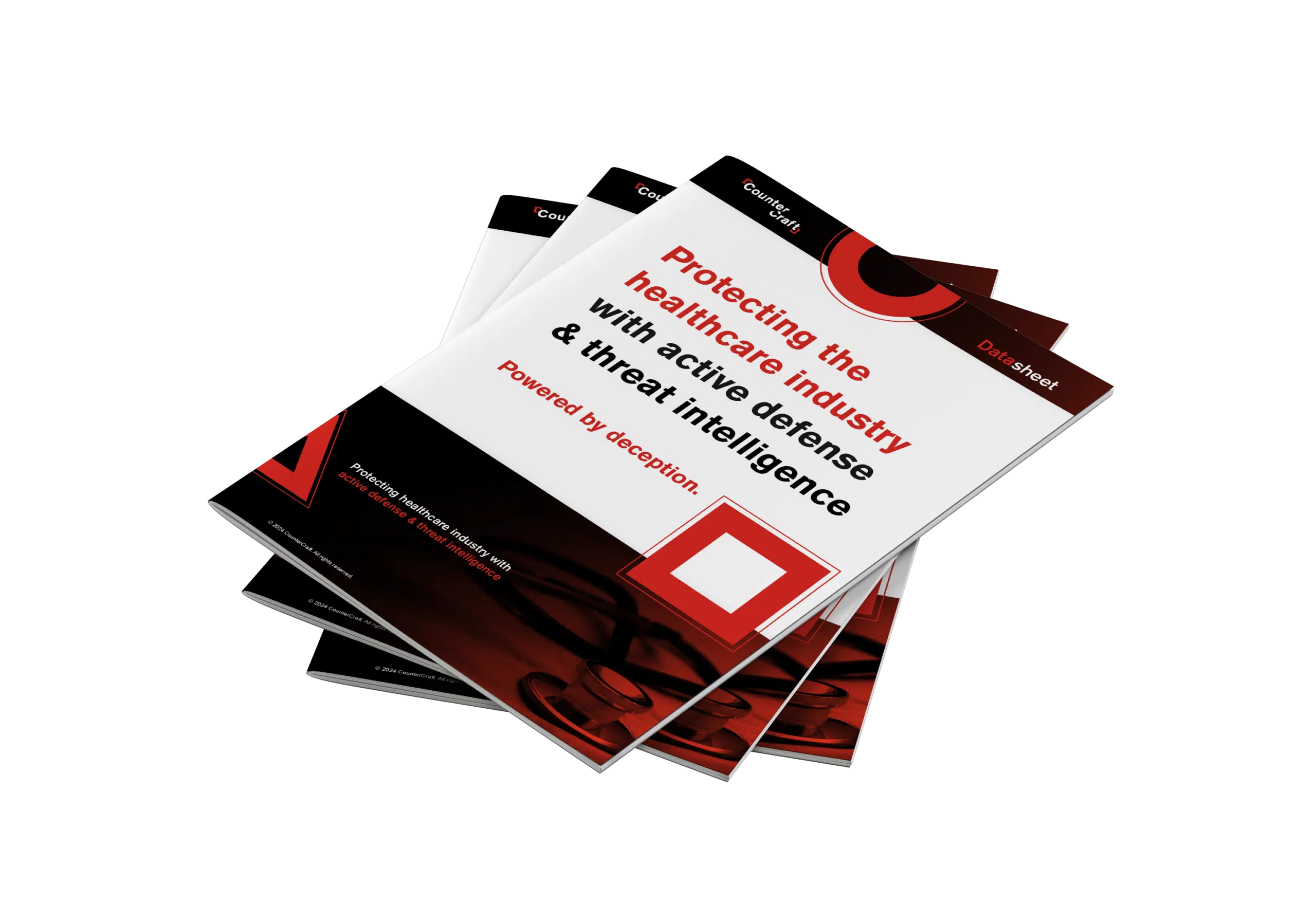
What you’ll learn:

How CounterCraft’s active defense combats ransomware and insider threats in healthcare, offering tailored protection for patient records and critical systems.

How CounterCraft’s active defense combats ransomware and insider threats in healthcare, offering tailored protection for patient records and critical systems.

How deception technology integrates easily with existing infrastructure and supports compliance with standards like FHIR and H7, ensuring seamless security and regulatory adherence.

How deception technology integrates easily with existing infrastructure and supports compliance with standards like FHIR and H7, ensuring seamless security and regulatory adherence.

Frequently Asked Questions (FAQ)
Healthcare organizations manage highly sensitive patient data and rely on critical systems such as electronic health records, imaging platforms, and clinical operations technology. A cyberattack can disrupt patient care, expose protected health information, and lead to financial and regulatory consequences. Strong cybersecurity is essential to protect patients, maintain availability of care, and preserve trust.
Healthcare is a frequent target for ransomware, data theft, insider misuse, and advanced persistent threats. Attackers are drawn to environments where downtime is costly and systems are often difficult to patch. These threats can impact clinical workflows, patient safety, and data confidentiality.
CounterCraft places realistic decoy assets that reflect healthcare systems and network structures. When attackers interact with these assets, the platform captures real attacker behavior instead of inferred anomalies. This allows healthcare security teams to detect sophisticated threats earlier in the attack lifecycle. Find out how AI-powered deception works with a demo.
Yes. CounterCraft can reflect clinical networks and connected medical systems within controlled environments. This makes it possible to detect attempts to access or move toward medical devices without interacting with live systems. Patient care and system availability remain unaffected.
Decoy assets are not used by legitimate staff or systems. Any interaction with them signals malicious activity rather than normal behavior. This significantly reduces false positives and helps analysts focus on real threats.
Yes. CounterCraft integrates with SIEM, SOAR, and other security platforms commonly used in healthcare environments. Threat intelligence from attacker interactions can be consumed directly in existing workflows. This improves prioritization without adding operational complexity.
By improving visibility into real threats and attacker behavior, CounterCraft supports compliance with frameworks such as HIPAA and related data protection requirements. The intelligence it provides helps with incident investigation, reporting, and audit readiness. This strengthens security controls without disrupting clinical operations.
Security operations teams, SOC analysts, incident response teams, CISOs, and IT risk leaders benefit the most. These teams gain earlier visibility into threats and clearer context for decision-making. This is especially valuable in environments where uptime and patient safety are critical.
Healthcare organizations rely on continuous system availability and often operate complex, legacy-heavy environments. Attackers exploit this pressure, knowing downtime can force rapid decisions. Sensitive patient data also increases the value of successful attacks.
Protecting patient data requires early detection of malicious behavior, not just perimeter defenses. Visibility into attacker movement and intent helps teams intervene before data is accessed or exfiltrated. Behavior-based intelligence plays a key role in this approach.
Yes. By detecting attacker behavior around clinical systems and device networks, deception-based security can expose threats without interacting with live equipment. This reduces risk while maintaining patient safety and system stability.